Wednesday, 2 January 2013

Hepworth Dixon -Vintage or Classic?


It is said that with a treasured fountain pen, the writer assumes an air of accomplishment as they practice the art of fine handwriting. As we write, we express our innermost thoughts and passions to the world. A pen in the hand becomes an extension of the body and soul. Writing with a fountain pen is a romantic link to our past culture that allows a personal expression that cannot be emulated by today’s sterile forms of communication. Rising above the times a fountain pen will stay, and forever remain, the purest means of self-expression.

Hepworth Dixon specialises in the restoration of vintage fountain pens. We also offer a range of classic, modern classic and new-old-stock writing instruments.

What is a vintage fountain pen?

Fountain pens have been around for the past 130 years. Writing instruments with the ability to carry a self contained supply of ink were only introduced in the late 1800's. Lewis Waterman patented the first “practical” fountain pen in 1884, a design which allowed the controlled flow of ink from a reservoir to nib tip.

Vintage Parker Duofold Lucky Curve
Button Filling Fountain Pen
Manufactured 1926
Classic Parker Duofold Centennial
Cartridge/Convertor Filling Fountain Pen
Manufactured 1988


Time is not the only criteria used to define vintage, but rather other elements such as enduring style, perceived quality and accrued value. Vintage pens usually come from a different era, but the definition should not be confined only in years.

Why call some used pens “vintage”?

Much like you can have a great vintage wine from a few years back, so too can you have an outstanding vintage pen that is not technically that old. Some fountain pens are rare, simply because of their age. These often transcend the definition of vintage and move into the category of antique.

The value of these items illustrates that with time, vintage writing instruments can become rare and therefore more sought-after with increased value as a result.


Modern Classic
Montblanc Starwalker
Cartridge Filling Fountain Pen
Introduced 2003
Vintage Classic
Montblanc Meisterstuck 144
Piston Filling Fountain Pen
Produced early 1950's


So what is a "classic"? Let us begin with a dictionary definition.

Clas-sic (kla-sik) adj.

Belonging to the highest rank or class.
Serving as the established model or standard.
Having lasting significance or worth; enduring.
Formal, refined and restrained in style.
Simple and harmonious; elegant.


Vintage Classic Parker 51 Blue Diamond
Vacuum Filling Fountain Pen
Manufactured in 1947

What defines a fountain pen as being a "classic" ?

A Classic - "A pen considered to be the best of it's kind. It marks a high point in development for latter generations". Certainly no one would disagree that the Parker 51 (pictured above) fore-fills all the elements of dictionary definition of classic.

For different reasons, the Pelikan 100 and Sheaffer PFM (pictured below) should, also be considered as 'Classic' fountain pens of their era. The Pelikan 100 was the first fountain pen to adopt a 'Piston' filling system, first marketed in 1929.

Sheaffer introduced a plunge vacuum filling fountain pen with barrel reservoir  in 1935. In 1950 the 'Touchdown' evolved, replacing the barrel reservoir with an air pressure operated compression sac. A refinement in 1952, introducd a retractable snorkel filling tube. These were forerunner's to the 1959 Sheaffer PFM, probably the most technically advanced (perhaps over complicated) fountain pen ever produced.


Vintage Classic Pelikan 100 N
Piston Filling Fountain Pen
Manufactured c.1939
Classic Sheaffer PFM
Snorkel, Plunge Vacuum Filling
Fountain pen c.1959 


It becomes obvious, when attempting to clarify terms "Classic" and "Vintage" with regard to used fountain pens, there is no definitive answer. In conclusion, this remains a 'grey' area.

Outcome!

We have previously stated that pen definition "should not be confirmed only in years". Pre-defined 'pigeon holes' are however necessary to classify used fountain pens which are available for sale. This can only be achieved, in our opinion, based on manufacturing date or era.

Hepworth Dixon use the following categories when describing pens for sale:

Modern Classic - Post 1990 (specific model no longer produced)
Classic - 1970 to 1989
Late Vintage - 1950 to 1969
Early Vintage - 1920 to 1949
Antique - Pre 1920

An additional category 'NOS' new old stock. Used to describe a fountain pen model which is no longer produced, is contained within original packaging and has never been inked.

All Hepworth Dixon vintage fountain pens are sold in full working order, having been carefully restored to period specification. Our classic fountain pens are all scrupulously checked for functionality, repairs (if required) carried out, fully serviced and finally write tested.


Wednesday, 5 December 2012

What to buy a pen collector for Christmas!


As we approach that manic time of the year, trying to find the right gift for a loved one or friend who admires anything to do with traditional writing instruments can be perplexing.

We primarily restore vintage fountain pens, however, we do have available a wide range of pre-owned classic fountain pens in stock. These major brand classic's which are all genuine, but no longer in production make wonderful and thoughtful gifts for a fraction of the price of their modern counterparts. We have put together a small selection of these luxury fountain pens, all fully serviced and supplied in their original boxes. These pens and many others are available now from Hepworth Dixon Classic Pens.


Fountain pens pictured above, from top to bottom:-

1. Montblanc Noblesse Oblige in Dark Green
2. Dunhill Classique in Vermeil Barley

3. Aurora Kona in Burgundy

4. Montblanc Meisterstuck Classique in Burgundy

5. S.T. Dupont Classique Laque de Chine

6. Parker 180 Torsade 

Visit website www.hepworthdixon.com soon. See in detail all pens above and many more besides.

Sunday, 4 November 2012

Must de Cartier Vendome Fountain Pen

Cartier fountain pens are more than just a writing tool. They combine the precision of watch making with the exquisite opulence of jewellery, making Cartier fountain pens highly collectable.

In the early 1980's Cartier launched their 'must de Cartier Vendome' range of writing instruments. The Vendome is accented by 'Trinity Rings', three gold plated interwoven rings around top of cap. The yellow ring stands for faithfulness, the pink for love and the white for friendship. This pen proudly carries the Cartier double 'C' trademark, cast onto cap top.


Hepworth Dixon have recently fully serviced a wonderful pre-owned and cherished Cartier Vendome fountain pen and are pleased to be able to offer it for sale.

Pen has ink cartridge filling system. Features include; gold plated metal body in square panelled design, 18 carat solid gold nib, button operated retractable cap clip, lever mechanism to remove cassette cartridge holder and user rotational nib holder.


We believe this particular pen was manufactured c.1982. It is sold fully serviced, in original box with ink cartridge. For further information visit:
www.hepworthdixon.com/cartier_vendome.html 

Saturday, 27 October 2012

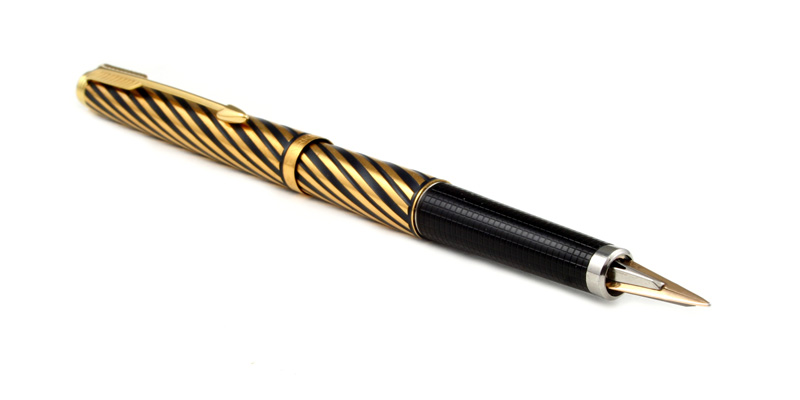
Rare Parker 180 'Torsade' Fountain Pen

Casual observers viewing this Parker 180 Torsade fountain pen with its spiralled black lacquer over gold  design would probably consider it to be "just another old Parker fountain pen from the 1980's". How wrong they would be! The serious Parker pen collector will realise that this particular 180 style, which was made in France during 1981, is indeed very rare.

Parker 180 'Torsade' Fountain Pen


The Parker 180 Torsade/spiral fountain pen was a limited production pen for the high end Jewelry Store market in Europe. The design of the Torsade (torsade being the French word for 'twist') is reminiscent of a barber pole or candy-stripe. It's design was created by incising alternating width groove spirals in the pen base metal. Parker coated the pen with a charcoal grey enamel lacquer, and polished the pen so the enamel lacquer only remained in the grooved spirals.

The effect of the lacquer and spirals is stunning, and provides the pen with a jeweled appearance. The trim of the pen is very similar to that of the Parker 75. The clip is the identical arrow clip that appears on the Parker 75, and the cap tassie is a similar beehive tassie, with a slightly different indentation from that of the later Parker 75 tassie. The barrel tassie is unique to the Parker 180. Date coding of 'UC' on cap band is 2nd quarter 1981 production


The Parker 180 is a slim pen, the nib style is quite unique -- it is flat and triangular in shape. The nib is a 14K solid gold fine point French nib, with the proper French gold marks on the nib. The designation of this pen, Parker '180' relates to the nib's flat design and ability to write in two different line styles. By rotating the pen in-hand through 180 degrees, the writer is provided with nib having two distinctly different degrees of flex.


We have examined the pen and could not find any defects in the finish. Pen is supplied in original Parker presentation case and like the pen it is in immaculate condition.This factor indicates that the pen was either not used or rarely used. The enamel appears to be the same as it was when it left the factory. We would rate the pen as in Near Mint to Mint condition. This pen is a superior representation of the Heritage series 180s and would make a worthy addition to any Parker fountain pen collection.

Whilst determining the providence of this pen, we were advised by a renowned authority on Parker pens that it was probably "a test run". A similar Parker 180 Torsade sold on e.bay in June 2012 for $552.

As with all Hepworth Dixon vintage and classic pens, we have cleaned, fully serviced and write tested this pen. It is now available to purchase from our website.


For further information and price, this pen can viewed on Hepworth Dixon website:

www.hepworthdixon.com/classic_fountain_pens.html

Wednesday, 24 October 2012

Vintage Fountain Pen Repair

At Hepworth Dixon we are constantly being asked "Are you able to supply parts, materials and tools for fountain pen repair". We have supplied the occasional item to long standing customers, but this practice as always been on an 'ad-hoc' basis.

As demand has increased significantly in recent months, we have decided to take the step of listing and offering a range of basic pen repair items which can be acquired directly from our website. Items have been placed in three categories; parts, materials and tools.

  • Parts - Ink sacs, pressure bars, 'J' bars, seals etc.
  • Materials - Shellac, silicone grease, French chalk, abrasive sticks, polishing paste.
  • Tools - Flushing bulb, knock-out block, Vacumatic wrench, pellet pusher, barrel and cap brushes.

Pen Restoration - Materials
Pen Restoration - Tools


Repairing and restoring your own vintage writing instrument can be highly satisfying and rewarding. It is however a project which should not be attempted on a whim, mistakes  can work out costly. Knowledge is the key. Understanding vintage pen design, materials of construction, methods of joint sealing, operating mechanisms and the various weaknesses, quirks for a given fountain pen.


Pen Restoration - Parts
There are many sources of reference available in books and on the internet, with information on the various process and techniques involved. We would highly recommend 'Pen Repair - Second Edition' by Jim Marshall and Laurence Oldfield. This book provides an excellent insight into general restoration techniques along with detailed procedural steps for specific pen models.

For more information and availability of pen restoration tools, materials and parts visit:

Friday, 19 October 2012

Montblanc 234 1/2 Fountain Pen - Fully Restored

Produced in the 1940's and recently restored by Hepworth Dixon. This stunning Montblanc 234 1/2 vintage fountain pen is now offered for sale via our website.


Restoration involved a full overhaul of telescopic spiral filling mechanism, the original cork seal had shrunk allowing ink to ingress internal workings at rear of pen barrel. Unused for decades, dried ink now clogged spiral flutes resulting in total seizure.

Having carefully retracted piston assembly through rear of pen, we set about the task of intricately restoring individual spiral telescopic sections. Image on below shows our newly restored piston assembly, fitted with new wax sealed, two part cork barrel seal.


Restored piston assembly shown
at three levels of extension
The amber ink view window on this pen is very clear. What many do not realise is that the whole barrel is in fact made from amber coloured resin. The gloss black appearance was achieved by by dipping the amber body, including thread section in black celluloid with the ink view window masked off. Over zealous owners could easily over polish their prized position, wearing away the outer black coating, resulting in unwanted barrel transparency.

Clear amber ink view window
The inside of ink view widow on this 234 was heavily ink stained, even after ultrasonic cleaning. By internally plugging barrel with rubber bungs to protect blackened areas, we were able to polish window, removing  ink stains effectively.


The same level of care must be adopted when attempting to polish barrel exterior. Fortunately this 234 was free of dents and abrasions, so only very fine cut plastic polish was needed to bring up a gloss shine. Cap is made soley from black celluloid, so with cap rings and Montblanc lettering masked and clip removed, hand polishing soon brought surface finish back to a high standard.


Nib has been tested, and is proven to be manufactured from stainless steel. This material was used extensively during the war years as gold had become scarce and hard to obtain. Nibs of this period were also made of Palladium, very few as the cost of palladium was very similar to that of gold.                                                                                                                                                              Initial impressions of a quality Montblanc fountain being fitted with a steel nib were questionable. Having written with this pen, any doubts on nib performance had been totally unfounded, it writes beautifully.

Overall this has been a particularly satisfying restoration project. Now complete, this rare fountain pen is available to purchase through our website: 

Collectors of fine vintage fountain pens can read detailed description, and view many more images. 


Saturday, 13 October 2012

Pelikan 100N - Fully Restored


Very occasionally, when acquiring vintage fountain pens for restoration, we come across something a little special. This was the case with a late 1940's rare Pelikan 100N piston filling fountain pen with grooved clip and ribbed centre band.


On initial inspection, even before unscrewing the cap, it was obvious that pen had seen little use in the past sixty years. The impressed Pelikan logo to top of cap was deep with no loss of infill paint, gold filled clip and centre band showed no sign of rubbing or plating loss.
The delicate procedure of removing piston filling mechanism revealed that barrel internal bore was heavily soiled with dried ink, also elastomer resin piston seal had hardened and shrunk. The usual process of soaking and rubbing seal in warm oil did not rejuvenate seal sufficiently to provide an adequate suction for piston to draw ink when filling.


Early Pelikan 100's had cork seals on piston, a reversion to this type of seal was going to be the best option to ensure good filling and sealing characteristics on our pen. Dried ink was removed from barrel bore, this was then internally polished to remove all scratches which had been caused by hardened old seal. A new piston head was turned from acrylic resin, along with left handed threaded locking/adjusting cap.

Using two separate layers of natural cork bonded together, a larger than required disc was cut with a hole drilled through the centre to fit snugly over piston spindle. Using a lathe, the cork seal was sanded to size whilst mounted on rotating piston spindle. Cork seal then sealed and lubricated by boiling in sterin wax. Restored spiral piston and knob assembly refitted into rear of barrel, allowing final adjustment of piston seal against internal barrel, expanding cork by means of threaded seal cap through nib section end of barrel. Pen now draws full volume of ink when filling.
Setting original 14 carat gold nib, adjusting feeder and delicate hand polishing of barrel/cap external surfaces completed this pen restoration project.


This fully restored Pelikan 100N fountain pen is currently available to purchase from the Hepworth Dixon website, here you will find full description, many more images and price information.